


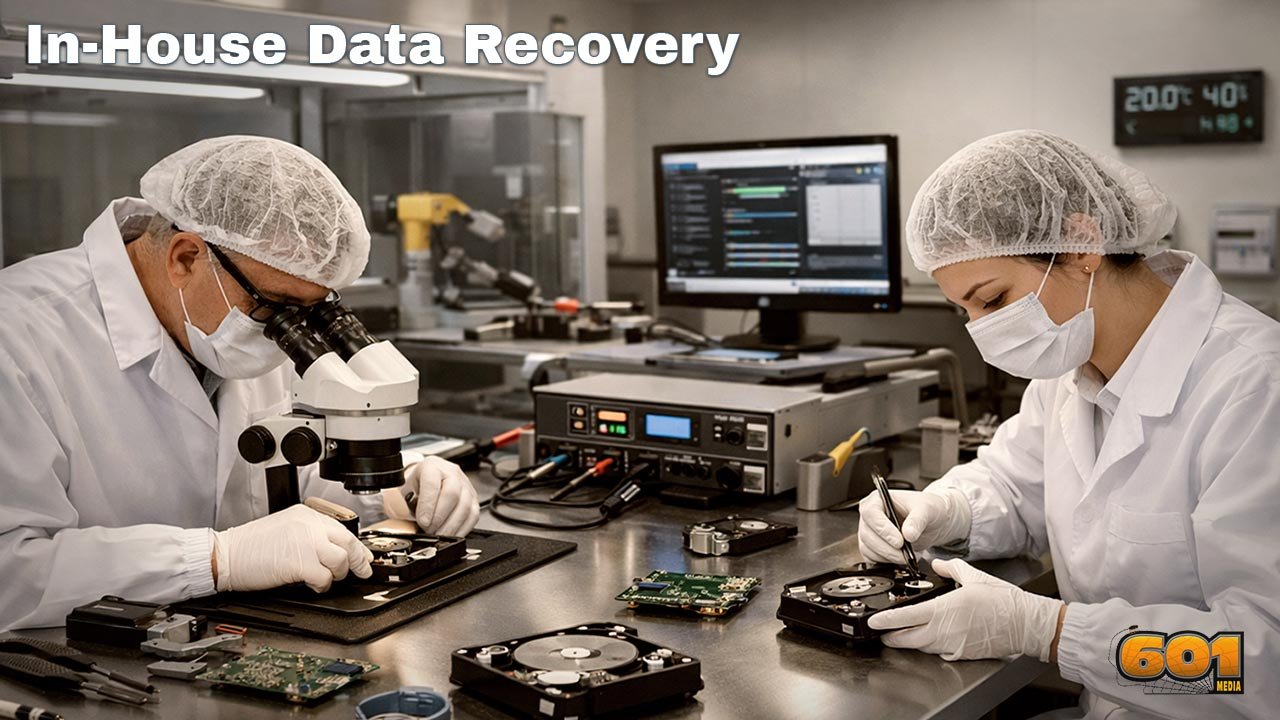
In-House Data Recovery: A Strategic Advantage for Modern Enterprises
In-house data recovery refers to an organization’s ability to diagnose, repair, and restore lost or corrupted data using internal resources rather than relying on external service providers. As data volumes expand and operational dependence on digital systems deepens, this capability is no longer optional. It has become a competitive necessity for enterprises prioritizing resilience, speed, and security.
Table of Contents
What Is In-House Data Recovery
In-house data recovery is the practice of restoring lost, deleted, or inaccessible data using internal staff, tools, and infrastructure. It applies to failures involving hard drives, SSDs, RAID arrays, virtual machines, databases, and cloud-integrated systems. Unlike outsourced recovery, which requires shipping hardware or granting external system access, in-house recovery keeps data within the organization’s control. This distinction is critical in regulated industries where data custody, privacy, and auditability are non-negotiable.
Why In-House Data Recovery Matters
Downtime is expensive. According to industry studies, the average cost of IT downtime exceeds $9,000 per minute for large enterprises. When recovery depends on third parties, delays multiply due to logistics, queues, and contractual limitations. In-house recovery directly addresses this risk by shortening recovery time objectives and enabling immediate response. More importantly, it aligns recovery operations with business priorities rather than vendor availability.
Key Components of In-House Data Recovery
Effective in-house data recovery requires a combination of technology, expertise, and governance. Skilled personnel are the foundation. This includes IT administrators trained in file systems, storage architectures, RAID logic, virtualization platforms, and forensic recovery techniques. Specialized software tools are equally critical. These tools must support logical recovery, disk imaging, RAID reconstruction, and database repair across multiple operating systems. Hardware capability matters. Write blockers, clean workspaces, redundant storage, and diagnostic equipment allow safe recovery without compounding damage. Finally, documented processes ensure consistency. Playbooks, escalation paths, and validation steps prevent ad-hoc decisions during high-pressure incidents.
Benefits Over Outsourcing
The most immediate benefit of in-house data recovery is speed. Internal teams can begin recovery within minutes rather than days. Cost efficiency improves over time. While initial investment is higher, organizations eliminate recurring vendor fees and unpredictable emergency charges. Security and compliance are strengthened. Sensitive data never leaves organizational custody, reducing breach exposure and audit complexity. Strategic control is another advantage. Recovery priorities align with operational impact rather than service-level agreements negotiated months earlier.
Implementation Strategy
Successful implementation begins with assessment. Organizations must evaluate data criticality, failure frequency, and regulatory exposure. Next is capability design. This includes selecting recovery tools compatible with existing infrastructure and defining which recovery scenarios will be handled internally versus escalated externally. Training is non-negotiable. Recovery skills degrade without practice. Regular simulations and post-incident reviews ensure readiness. Governance completes the strategy. Recovery authority, documentation standards, and audit trails must be clearly defined to avoid operational and legal ambiguity.
Risks and Limitations
In-house recovery is not without risk. Improper handling can permanently destroy recoverable data. Highly complex physical failures may still require clean-room intervention beyond internal capability. There is also talent risk. Skilled recovery professionals are scarce, and turnover can weaken capability if knowledge is not institutionalized. Organizations mitigate these risks by defining clear thresholds for escalation and maintaining hybrid models where extreme cases are outsourced.
Industry Use Cases
Financial institutions rely on in-house recovery to meet regulatory timeframes and protect client confidentiality. Healthcare organizations use it to restore clinical systems without exposing patient data to third parties. Manufacturing firms depend on rapid recovery to minimize production downtime and supply chain disruption. Technology companies leverage in-house recovery to protect intellectual property and development environments.
Top 5 Frequently Asked Questions
Final Thoughts
In-house data recovery is no longer just a technical function. It is a strategic capability that strengthens resilience, reduces operational risk, and enhances data sovereignty. Organizations that invest in internal recovery capabilities gain faster response, stronger security, and long-term cost control. While outsourcing still has a role for extreme cases, reliance on it as a default is increasingly misaligned with modern data realities. The most important takeaway is simple: control over data recovery equals control over business continuity. Enterprises that recognize this will be better positioned to operate, compete, and innovate in a data-dependent world.
Resources

I am a huge enthusiast for Computers, AI, SEO-SEM, VFX, and Digital Audio-Graphics-Video. I’m a digital entrepreneur since 1992. Articles include AI assisted research. Always Keep Learning! Notice: All content is published for educational and entertainment purposes only. NOT LIFE, HEALTH, SURVIVAL, FINANCIAL, BUSINESS, LEGAL OR ANY OTHER ADVICE. Learn more about Mark Mayo