


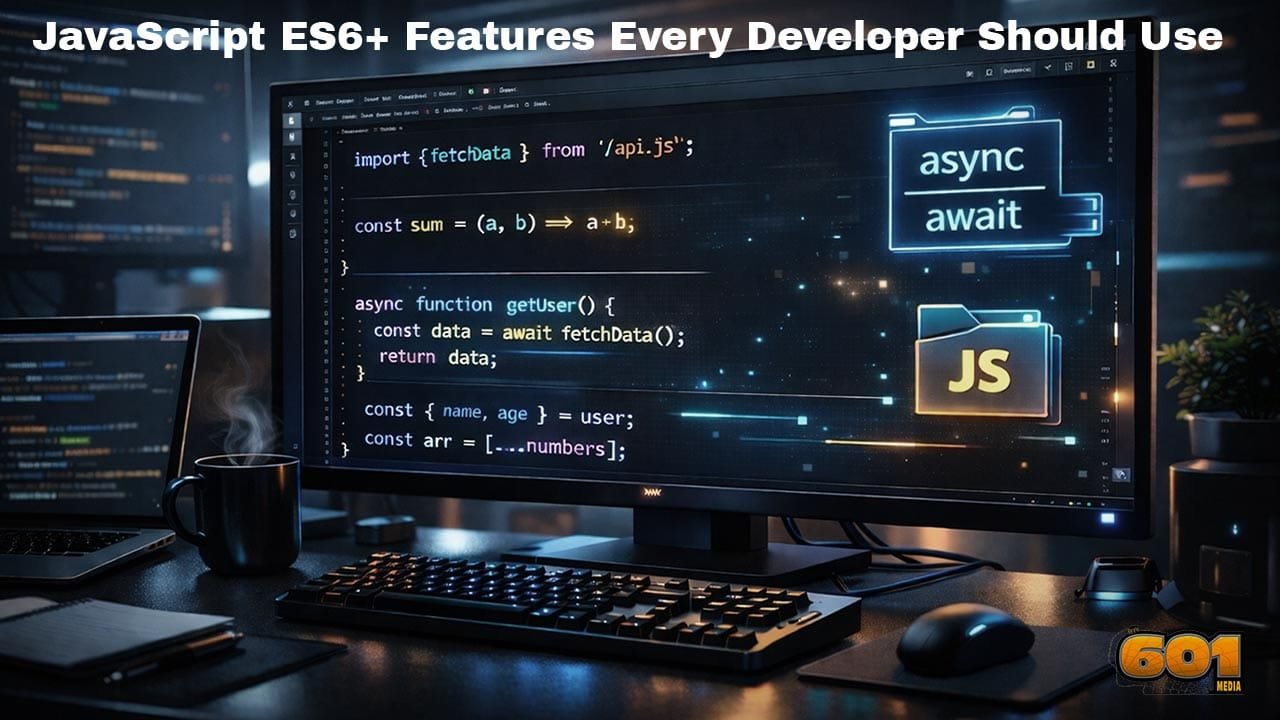
JavaScript ES6+ Features Every Developer Should Use
JavaScript has evolved from a simple scripting language into the backbone of modern web, mobile, and cloud applications. ES6, officially known as ECMAScript 2015, marked a turning point by introducing features that dramatically improved readability, maintainability, and performance. Every version since has continued that evolution. Understanding ES6+ is no longer optional—it is foundational for professional JavaScript development. You will learn how these features improve code clarity, reduce bugs, and support scalable application architecture, with practical examples and real-world impact.
Table of Contents
- Block Scoped Variables: let and const
- Arrow Functions
- Template Literals
- Destructuring Assignment
- Spread and Rest Operators
- ES Modules
- Classes and Object-Oriented Enhancements
- Async and Await
- Optional Chaining and Nullish Coalescing
- Private Class Fields for True Encapsulation with #
- Top 5 Frequently Asked Questions
- Final Thoughts
- Resources
Block Scoped Variables: let and const
Before ES6, JavaScript relied exclusively on var, which introduced function-level scoping and unpredictable behavior due to hoisting. ES6 introduced let and const to fix these issues. let creates variables limited to block scope, preventing accidental overwrites. const ensures that references cannot be reassigned, reinforcing immutability patterns widely used in modern software design. According to Google’s JavaScript style guidelines, using const by default reduces unintended side effects and improves code reliability.
Arrow Functions
Arrow functions simplify function syntax and remove ambiguity around the this keyword. Unlike traditional functions, arrow functions inherit this from their surrounding scope, making them ideal for callbacks, promises, and event handlers. This feature significantly reduced bugs in asynchronous codebases. Frameworks such as React and Vue rely heavily on arrow functions for predictable component behavior.
Template Literals
Template literals replace string concatenation with readable inline expressions using backticks. They support variable interpolation, multi-line strings, and embedded expressions. This feature improves readability and reduces errors when generating dynamic content, especially in server-side rendering, logging systems, and UI templates.
Destructuring Assignment
Destructuring allows developers to extract values from arrays or objects directly into variables. This reduces boilerplate code and improves semantic clarity. Destructuring is especially useful in API responses, function parameters, and state management systems. Research from GitHub’s Octoverse reports shows destructuring is among the most used ES6 features in open-source JavaScript projects.
Spread and Rest Operators
The spread operator expands iterable values, while the rest operator gathers them into arrays. Together, they enable immutable data manipulation, a cornerstone of modern frontend architecture. They are heavily used in Redux, functional programming patterns, and state updates where immutability is critical for performance and debugging.
ES Modules
ES modules standardized how JavaScript code is organized and shared. Using import and export statements enables clear dependency management and tree-shaking, which reduces bundle size. Modern browsers and Node.js support ES modules natively, making them the default standard for scalable applications.
Classes and Object-Oriented Enhancements
ES6 introduced class syntax as a cleaner abstraction over JavaScript’s prototype system. While JavaScript remains prototype-based, classes make object-oriented patterns more accessible and readable. Classes support inheritance, constructors, and static methods, which simplifies large application architecture and aligns JavaScript with other enterprise languages.
Async and Await
Async and await transformed asynchronous JavaScript. Built on Promises, they allow asynchronous code to be written in a synchronous style, improving readability and error handling. Studies from Microsoft engineering teams show async/await reduces debugging time by making execution flow more predictable.
Optional Chaining and Nullish Coalescing
Optional chaining prevents runtime errors when accessing deeply nested properties. Nullish coalescing provides safe default values when dealing with null or undefined. These features significantly reduce defensive coding patterns and improve application stability, especially in data-driven applications consuming external APIs.
Private Class Fields for True Encapsulation with #
ES6+ didn’t just modernize syntax—it also made JavaScript feel more like a “serious” language for large-scale software engineering. One of the biggest leaps is private class fields, written with a leading #. These fields are genuinely private at the language level, not “private by convention.”
With #privateField, access is restricted to the class body only. No external reads, no accidental overwrites, no sneaky access through this[“fieldName”], and no reliance on closures or WeakMaps for privacy. That means cleaner code and fewer ways for state to leak or get corrupted.
Private fields are especially valuable in complex applications where objects represent domain entities (users, invoices, sessions, feature flags) and you must protect internal invariants. Instead of hoping other developers respect a naming convention like _balance, the runtime enforces privacy for you.
Why # Private Fields Are a Game Changer
- Real encapsulation: Internal state is inaccessible outside the class, which prevents misuse and reduces debugging time.
- Safer refactoring: When state is truly private, you can change internal storage or calculations without breaking external code.
- Clearer public API: Consumers interact through methods and properties you intentionally expose, rather than poking at internals.
- Fewer side effects: You minimize accidental writes that cause unpredictable behavior.
Proper Getters and Setters: Controlled Access Without Leaks
Private fields pair perfectly with getters and setters, letting you expose a clean public interface while still keeping the underlying data protected. This is where it becomes a real architectural advantage: you can enforce rules, validate inputs, and keep your object in a valid state—without giving up convenience.
For example, you might store a private #price and expose a public price property:
- A getter can compute derived values, format output, or apply business logic before returning data.
- A setter can validate types, enforce ranges, normalize input, or reject invalid state changes.
This pattern is a huge win for maintainability in production systems because it turns “random property mutation” into a controlled workflow. You can also add logging, analytics hooks, deprecation warnings, or permission checks later—without changing the external API. That kind of stability is exactly what large teams and long-lived products need.
Example Structure (Conceptual)
A typical approach is:
- Store the real state in #private fields.
- Expose only what should be public via methods and get/set accessors.
- Use setters to enforce invariants so objects can’t enter broken states.
// ES6+ example showing private fields (#) with proper getters and setters

class BankAccount {
  #balance = 0;

  constructor(initialBalance) {
    this.balance = initialBalance; // uses setter
  }

  get balance() {
    return this.#balance;
  }

  set balance(amount) {
    if (amount < 0) {
      throw new Error("Balance cannot be negative");
    }
    this.#balance = amount;
  }

  deposit(amount) {
    this.balance += amount; // controlled update
  }
}

const account = new BankAccount(100);
account.deposit(50);

console.log(account.balance); // 150
account.balance = -10;        // ? throws error
console.log(account.#balance); // ? syntax error (truly private)
In short: # private fields give JavaScript true encapsulation, and getters/setters give you professional-grade control over how state is exposed and changed. Together, they fundamentally improve the way you design APIs, protect domain rules, and scale codebases without turning them into fragile piles of “do not touch” properties.
Top 5 Frequently Asked Questions
Final Thoughts
ES6+ features are not optional enhancements—they represent a fundamental shift in how JavaScript is written and maintained. Developers who embrace these features produce cleaner code, reduce bugs, and scale applications more effectively. Mastery of ES6+ is a clear indicator of modern JavaScript competence and a prerequisite for professional development in today’s technology landscape.
Resources

I am a huge enthusiast for Computers, AI, SEO-SEM, VFX, and Digital Audio-Graphics-Video. I’m a digital entrepreneur since 1992. Articles include AI assisted research. Always Keep Learning! Notice: All content is published for educational and entertainment purposes only. NOT LIFE, HEALTH, SURVIVAL, FINANCIAL, BUSINESS, LEGAL OR ANY OTHER ADVICE. Learn more about Mark Mayo