

IPv4 vs IPv6: Why the Internet Is Moving On
The internet is undergoing one of its most important infrastructure transitions since its creation. While most users never see it, the shift from IPv4 to IPv6 is reshaping how devices connect, scale, and remain secure in a hyper-connected world. IPv4 powered the early internet, but it was never designed for billions of smartphones, cloud servers, and IoT devices. IPv6 solves those limitations with massive address space, better performance, and modern security. This article explains why IPv6 is replacing IPv4 and what it means for businesses, developers, and everyday users.
Table of Contents
- What Is IPv4?
- What Is IPv6?
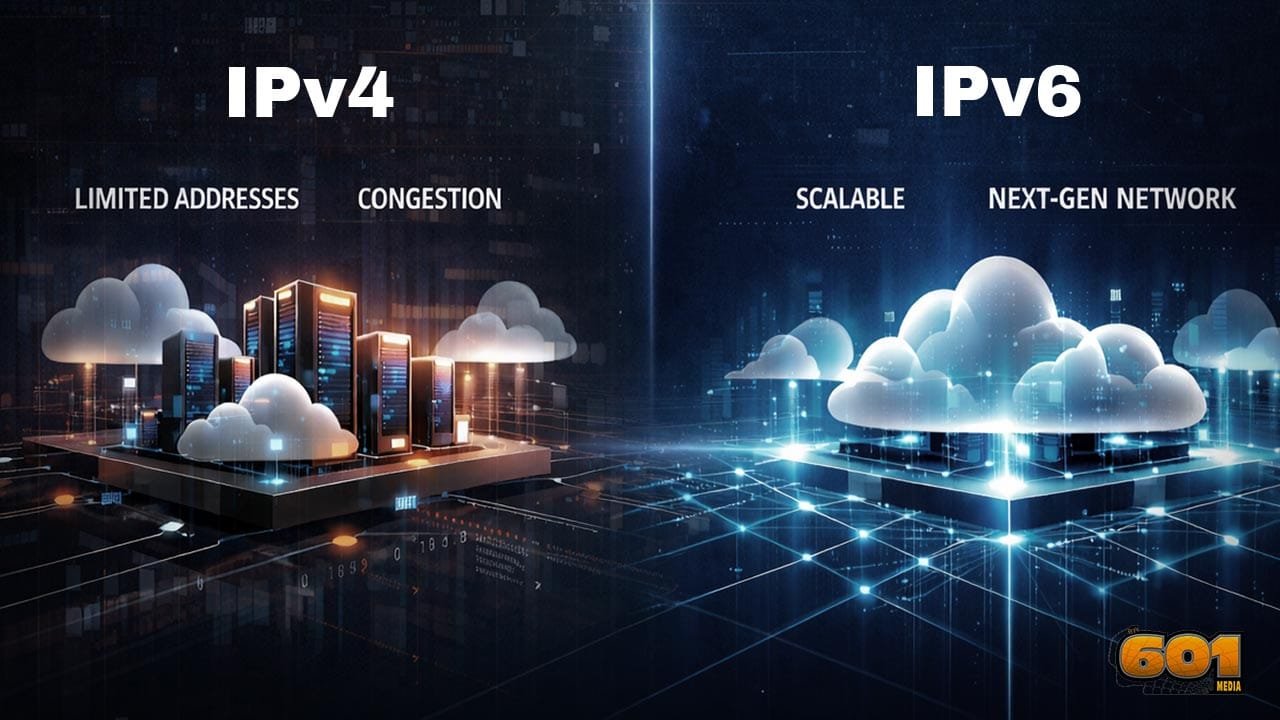
- Why IPv4 Reached Its Limits
- Key Differences Between IPv4 and IPv6
- Why the Internet Is Moving to IPv6
- Business and Technology Impact
- Current IPv6 Adoption Status
- The Future of Internet Protocols
- Top 5 Frequently Asked Questions
- Final Thoughts
- Resources
What Is IPv4?
IPv4, or Internet Protocol version 4, was introduced in 1983 as the foundational addressing system for the internet. It uses a 32-bit address format, allowing roughly 4.3 billion unique IP addresses. At the time, this seemed limitless. The internet was academic, centralized, and small. No one anticipated smartphones, streaming platforms, cloud computing, or smart refrigerators competing for addresses.
What Is IPv6?
IPv6, introduced in 1998, is the next-generation internet protocol. It uses 128-bit addresses, enabling approximately 340 undecillion unique IP addresses. That number is so large it effectively eliminates address scarcity forever. Beyond scale, IPv6 modernizes routing efficiency, security handling, and device configuration—aligning the internet with modern demands.
Why IPv4 Reached Its Limits
IPv4 exhaustion is not theoretical. The global IPv4 address pool officially ran out in 2011. To delay collapse, the internet relied on Network Address Translation (NAT), which allows multiple devices to share a single IP address. While effective as a temporary fix, NAT introduced complexity, latency, and security challenges. Peer-to-peer connections became harder. Application performance suffered. Innovation slowed. IPv4 simply cannot support a world with billions of always-connected devices.
Key Differences Between IPv4 and IPv6
IPv4 uses decimal notation, while IPv6 uses hexadecimal. IPv6 eliminates broadcast traffic, replacing it with more efficient multicast communication. Header structures are simplified, improving routing speed. Security is also native in IPv6. While IPv4 can use IPsec, IPv6 was designed with encryption and authentication as core features, not add-ons. Most importantly, IPv6 restores true end-to-end connectivity, allowing devices to communicate directly without NAT interference.
Why the Internet Is Moving to IPv6
The migration is driven by necessity, not preference. Cloud providers require massive address scalability. Mobile networks depend on efficient routing. IoT ecosystems cannot function with shared IP constraints. IPv6 is the only protocol capable of meeting these demands simultaneously. Major platforms including Google, Facebook, and Netflix report performance improvements of up to 15% when users connect over IPv6 versus IPv4.
Business and Technology Impact
For enterprises, IPv6 adoption reduces operational complexity and long-term costs. It eliminates address management workarounds and enables global service expansion without architectural redesign. Developers benefit from simplified networking logic. Security teams gain better visibility and encryption support. ISPs reduce infrastructure strain and improve customer experience. Ignoring IPv6 increasingly means falling behind.
Current IPv6 Adoption Status
As of today, over 40% of global internet traffic uses IPv6. Some regions, including parts of Asia and Europe, exceed 60% adoption. Mobile networks lead the transition, while enterprise networks lag due to legacy systems. However, IPv6 usage continues to grow steadily year over year. IPv4 is no longer the default future—it is technical debt.
The Future of Internet Protocols
IPv6 is not experimental. It is stable, proven, and essential. While IPv4 will persist in parallel for years, innovation will increasingly assume IPv6 availability. Emerging technologies like 5G, edge computing, and massive IoT deployments depend on it. The internet is not replacing IPv4 overnight—it is outgrowing it.
Top 5 Frequently Asked Questions
Final Thoughts
IPv6 is not a future upgrade—it is a present necessity. The shift reflects a broader truth in technology management: systems must evolve or become obstacles to innovation.
Organizations that adopt IPv6 early gain scalability, performance, and security advantages. Those that delay risk operational friction and reduced competitiveness in a network-first world.
Resources

I am a huge enthusiast for Computers, AI, SEO-SEM, VFX, and Digital Audio-Graphics-Video. I’m a digital entrepreneur since 1992. Articles include AI assisted research. Always Keep Learning! Notice: All content is published for educational and entertainment purposes only. NOT LIFE, HEALTH, SURVIVAL, FINANCIAL, BUSINESS, LEGAL OR ANY OTHER ADVICE. Learn more about Mark Mayo