

Create Video Games & Interactive Media in Unreal Engine 5
Unreal Engine 5 has redefined what is possible in video game development and interactive media creation. Built for high-fidelity visuals, scalable performance, and real-time workflows, it empowers developers to create immersive experiences across games, film, architecture, simulation, and virtual production. Whether you are an indie creator or part of an enterprise studio, Unreal Engine 5 provides a unified ecosystem for building next-generation interactive content.
What Makes Unreal Engine 5 a Game-Changer
At its core, Unreal Engine 5 focuses on removing traditional technical barriers that slow down creative production. The engine introduces breakthrough technologies that fundamentally change how developers think about assets, lighting, and world design. Developed by Epic Games, Unreal Engine 5 is designed to scale from small prototypes to AAA productions without rewriting systems or pipelines.
Table of Contents
- Nanite Virtualized Geometry
- Lumen Global Illumination
- Blueprints and C++ Development
- World Building and Level Design
- Interactive Media Beyond Games
- Performance and Optimization
- Publishing and Distribution
- Top 5 Frequently Asked Questions
- Final Thoughts
- Resources
Nanite Virtualized Geometry
Nanite allows developers to import film-quality assets directly into the engine without manual polygon reduction. This virtualized geometry system streams only the detail needed for each frame, enabling environments with billions of polygons while maintaining performance. For developers, this means faster iteration, fewer asset compromises, and dramatically improved visual fidelity.
Lumen Global Illumination and Reflections
Lumen introduces fully dynamic global illumination and reflections. Unlike baked lighting workflows, Lumen reacts in real time to changes in geometry, light sources, and materials. This allows for realistic lighting in dynamic worlds, day-night cycles, destructible environments, and interactive scenes without costly light rebuilds.
Blueprints and C++ Development
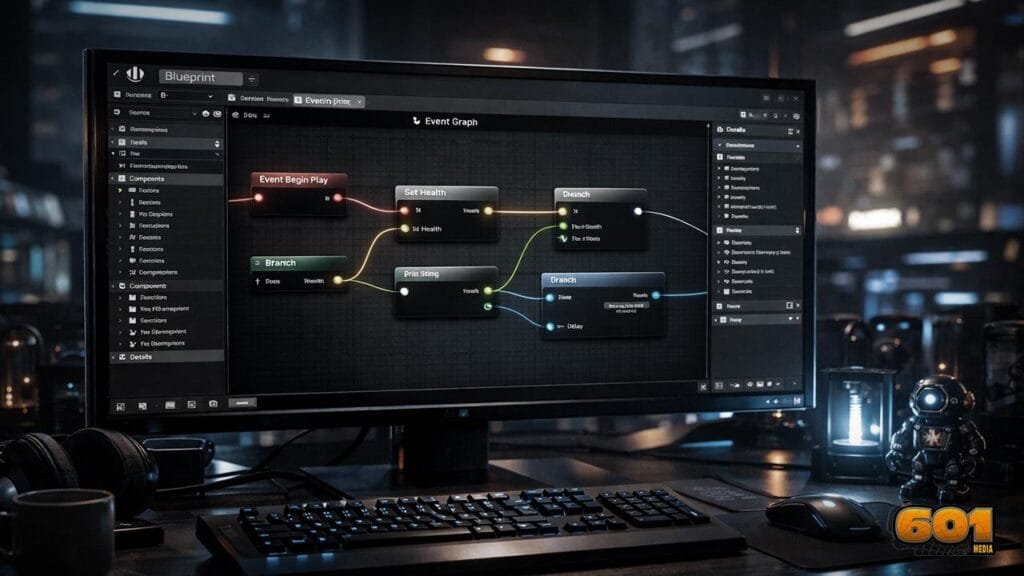
Unreal Engine 5 supports both visual scripting through Blueprints and traditional C++ programming. Blueprints allow rapid prototyping and iteration without writing code, while C++ provides full control over performance-critical systems. This hybrid approach enables teams with diverse skill sets to collaborate efficiently and scale projects as complexity grows.
World Building and Level Design
With tools like World Partition, Data Layers, and One File Per Actor, Unreal Engine 5 simplifies large-scale world creation. Developers can build massive open worlds while maintaining team collaboration and performance. Streaming systems load only what the player needs, allowing seamless exploration without loading screens.
Interactive Media Beyond Games
Unreal Engine 5 is not limited to traditional gaming. It is widely used for virtual production, architectural visualization, automotive design, training simulations, and real-time experiences. Its real-time rendering capabilities allow creators to produce cinematic content, interactive installations, and digital twins with unprecedented speed and realism.
Performance and Optimization Strategies
Despite its advanced features, performance optimization remains critical. Unreal Engine 5 provides profiling tools such as Unreal Insights, Nanite visualization modes, and GPU profiling. Developers can balance visual fidelity and frame rate through scalability settings, asset streaming, and platform-specific optimization workflows.
Publishing and Distribution
Unreal Engine 5 supports deployment across PC, consoles, mobile devices, and XR platforms. Integrated build systems, packaging tools, and platform SDK support simplify the release process. Developers can distribute through major storefronts or deploy enterprise applications without separate pipelines.
Top 5 Frequently Asked Questions
Final Thoughts
Unreal Engine 5 represents a fundamental shift in how interactive experiences are created. By removing technical bottlenecks in geometry, lighting, and world building, it allows creators to focus on design, storytelling, and innovation. Whether developing games or immersive interactive media, Unreal Engine 5 provides a future-proof platform capable of supporting the next decade of real-time experiences.
Resources

I am a huge enthusiast for Computers, AI, SEO-SEM, VFX, and Digital Audio-Graphics-Video. I’m a digital entrepreneur since 1992. Articles include AI assisted research. Always Keep Learning! Notice: All content is published for educational and entertainment purposes only. NOT LIFE, HEALTH, SURVIVAL, FINANCIAL, BUSINESS, LEGAL OR ANY OTHER ADVICE. Learn more about Mark Mayo