


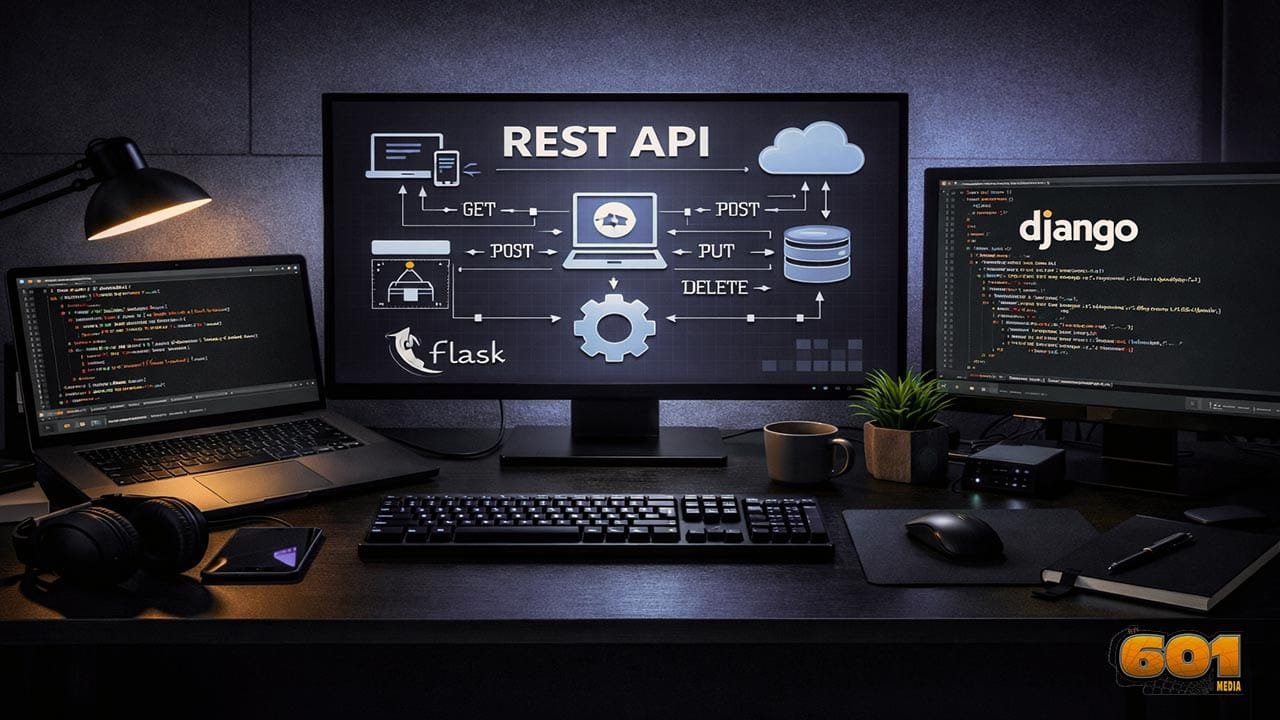
Building REST APIs with Python Using Flask and Django
Modern digital products depend on fast, secure, and scalable communication between systems. REST APIs power that communication layer, enabling web apps, mobile apps, IoT devices, and enterprise platforms to exchange data reliably. Python has emerged as a dominant language for API development due to its simplicity, mature ecosystem, and strong community support. This article provides a comprehensive, practical guide to building REST APIs with Python using Flask and Django, focusing on architecture, best practices, performance, and real-world scalability.
Table of Contents
- Understanding REST API Fundamentals
- Why Python Is Ideal for REST APIs
- Building REST APIs with Flask
- Building REST APIs with Django
- Flask vs Django for API Development
- API Security Best Practices
- Performance and Scalability
- Testing and Documentation
- Deployment and Production Readiness
- Top 5 Frequently Asked Questions
- Final Thoughts
- Resources
Understanding REST API Fundamentals
REST, or Representational State Transfer, is an architectural style built around stateless communication, resource-based URLs, and standard HTTP methods. REST APIs rely on predictable patterns that make systems easier to scale and maintain. Each request contains all the information required to process it, eliminating server-side session storage and improving horizontal scalability. Core REST principles include client-server separation, statelessness, cacheability, layered architecture, and uniform interfaces. Resources are typically represented as JSON, which has become the industry standard due to its readability and compatibility with frontend frameworks.
Why Python Is Ideal for REST APIs
Python consistently ranks among the top programming languages due to its readability, rapid development capabilities, and massive ecosystem. According to Stack Overflow’s Developer Survey, Python remains one of the most loved and wanted languages for backend development. Python accelerates API development through expressive syntax, strong typing support, and battle-tested libraries. Frameworks like Flask and Django allow developers to focus on business logic rather than boilerplate code. Python’s compatibility with cloud platforms, data pipelines, and machine learning systems further strengthens its position as an API-first language.
Building REST APIs with Flask
Flask is a lightweight microframework designed for flexibility and simplicity. It provides routing, request handling, and response generation without enforcing strict architectural patterns. This makes Flask ideal for microservices, MVPs, and APIs with narrowly defined responsibilities. A Flask REST API typically defines routes mapped to HTTP methods such as GET, POST, PUT, and DELETE. Extensions like Flask-RESTful and Flask-SQLAlchemy simplify request parsing, serialization, and database integration. Flask’s minimal footprint allows teams to assemble only the components they need, improving performance and maintainability. Flask excels when teams want fine-grained control over architecture, dependency selection, and request handling behavior.
Building REST APIs with Django
Django is a full-stack web framework designed for large-scale, data-driven applications. When combined with Django REST Framework (DRF), it becomes a powerful platform for building enterprise-grade APIs. Django REST Framework introduces serializers, viewsets, authentication backends, and permission classes that significantly reduce development time. Built-in features like ORM integration, migrations, admin dashboards, and security middleware make Django an excellent choice for complex APIs with extensive business logic. Django favors convention over configuration, providing consistent project structures that support long-term maintainability and team collaboration.
Flask vs Django for API Development
Flask offers flexibility, minimalism, and faster initial setup, making it ideal for microservices and performance-sensitive APIs. Django emphasizes structure, built-in security, and rapid scaling, which suits enterprise platforms and data-heavy applications. Performance benchmarks show Flask APIs often outperform Django for simple endpoints due to lower overhead, while Django scales more predictably for complex relational data models. The choice ultimately depends on project scope, team experience, and long-term growth requirements.
API Security Best Practices
API security is non-negotiable in production systems. Common security measures include authentication, authorization, encryption, and rate limiting. Token-based authentication using JWT is widely adopted for stateless APIs. HTTPS encryption protects data in transit, while input validation prevents injection attacks. Django provides built-in CSRF protection and security middleware, while Flask relies on extensions to achieve equivalent protections. Logging, monitoring, and automated vulnerability scanning are critical for maintaining long-term security posture.
Performance and Scalability
High-performing APIs require efficient database queries, caching strategies, and asynchronous request handling. Tools like Redis and Memcached reduce database load by caching frequent responses. Python frameworks support asynchronous processing through ASGI servers and background task queues. Horizontal scaling using container orchestration platforms allows APIs to handle millions of requests with predictable latency.
Testing and Documentation
Automated testing ensures API reliability and prevents regressions. Unit tests validate business logic, while integration tests verify endpoint behavior. Flask and Django both support PyTest for scalable test automation. Clear API documentation improves developer adoption. OpenAPI specifications allow teams to generate interactive documentation and client SDKs automatically, reducing integration friction.
Deployment and Production Readiness
Production APIs require robust deployment pipelines, environment isolation, and monitoring. Containerization simplifies deployment consistency, while CI/CD pipelines automate testing and releases. Observability tools track latency, error rates, and traffic patterns. Proper logging and alerting reduce downtime and improve incident response.
Top 5 Frequently Asked Questions
Final Thoughts
Building REST APIs with Python using Flask or Django empowers teams to deliver scalable, secure, and maintainable digital products. Flask provides speed and flexibility, while Django offers structure and enterprise readiness. Choosing the right framework is less about popularity and more about aligning technical decisions with business goals, scalability needs, and team expertise. Mastery of API fundamentals, security, and performance optimization remains the key differentiator in modern software architecture.
Resources
- Python Software Foundation Documentation
- Django REST Framework Official Guide
- Flask Official Documentation
- OWASP API Security Top 10
- Stack Overflow Developer Survey

I am a huge enthusiast for Computers, AI, SEO-SEM, VFX, and Digital Audio-Graphics-Video. I’m a digital entrepreneur since 1992. Articles include AI assisted research. Always Keep Learning! Notice: All content is published for educational and entertainment purposes only. NOT LIFE, HEALTH, SURVIVAL, FINANCIAL, BUSINESS, LEGAL OR ANY OTHER ADVICE. Learn more about Mark Mayo